Introduction
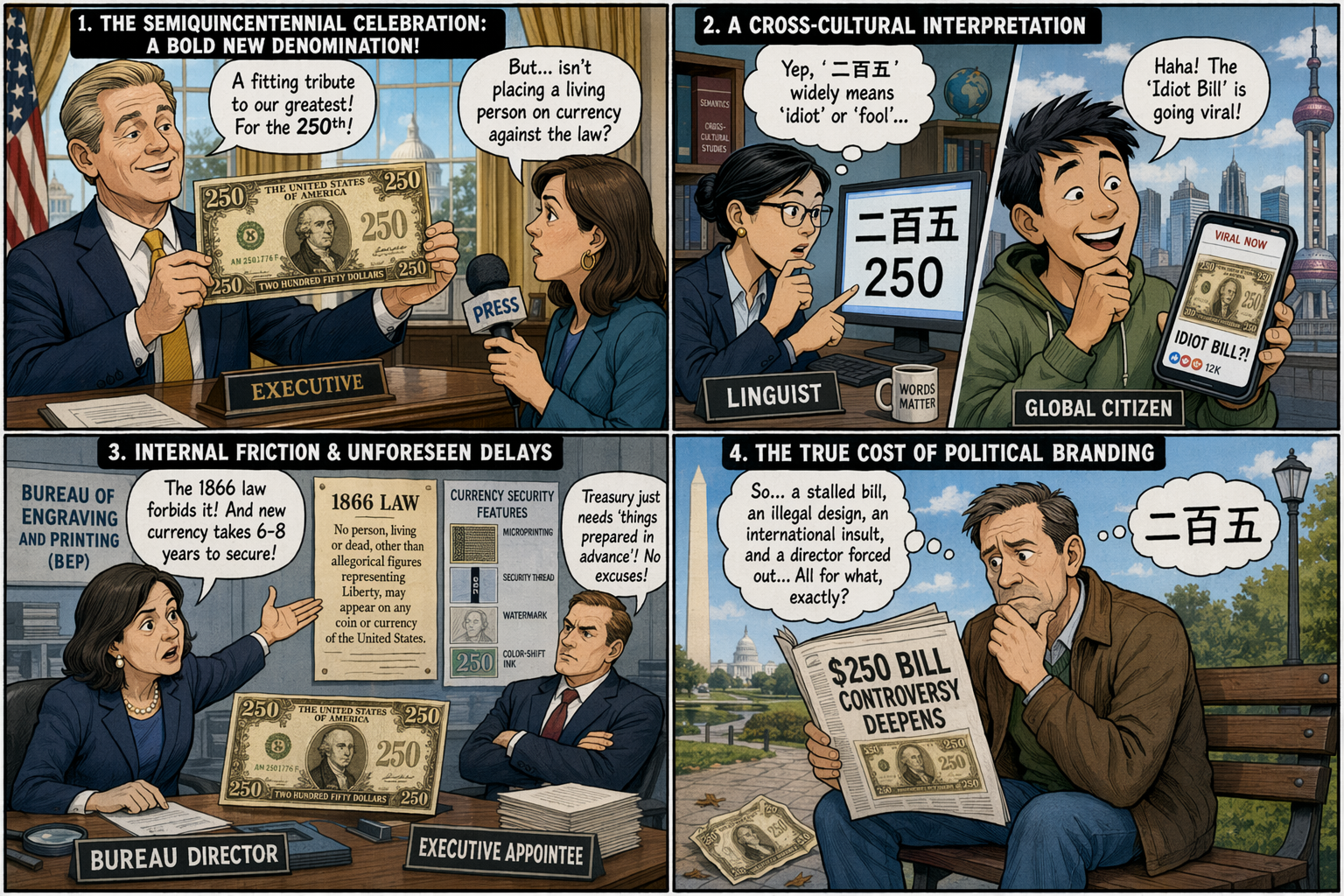
The intersection of domestic political symbolism and global linguistic interpretation occasionally produces phenomena that defy conventional public relations management. In the extended preparations for the United States Semiquincentennial in 2026, a proposal to introduce a new $250 federal reserve note featuring the portrait of President Donald Trump became the epicenter of a massive, multi-continental viral controversy. Conceived by its political proponents as a patriotic tribute and an economic countermeasure to inflation, the initiative inadvertently collided with a deeply entrenched linguistic reality: in Mandarin Chinese, the number 250 (èrbǎiwǔ, 二百五) is a centuries-old colloquial insult meaning "idiot," "fool," or "dimwit" [cite: 1, 2, 3].
This exhaustive research report investigates the multifaceted dynamics driving this viral narrative. By dissecting the legislative origins of the proposal, the resulting bureaucratic friction within the U.S. Treasury, the macroeconomic implications of expanding currency denominations, and the cultural etiology of Chinese slang, the analysis separates verified facts from circumstantial inferences and disputed claims. Furthermore, the report traces the specific drivers of the May and June 2026 social media explosion, illuminating how a domestic campaign for presidential legacy propagated across digital borders to become a source of international mockery and intensive fact-checking demand.
Drivers of Social Media Heat and Fact-Checking Demand
The controversy surrounding the $250 bill did not emerge uniformly; rather, it incubated in legislative and bureaucratic circles before exploding into public consciousness in May and June 2026. The sudden surge in search traffic and social media engagement was catalyzed by a highly visible convergence of press briefings, leaked internal government communications, and transnational media reporting.
The primary domestic trigger was a White House press briefing on May 28, 2026. Fox News reporter Peter Doocy directly questioned Treasury Secretary Scott Bessent, asking, "How long until we see your signature next to President Trump's face on a $250 bill?" [cite: 4, 5]. Bessent confirmed that while current law prohibits living persons on U.S. currency, the Treasury had "prepared things in advance" should proposed legislation pass, defending the initiative by stating there was nothing "untoward about having the president of the United States on the 250th anniversary bill" [cite: 5, 6, 7, 8].
This televised admission served as an accelerant. The footage immediately circulated across platforms including X (formerly Twitter), Reddit, Threads, and YouTube [cite: 3, 4, 9]. Consequently, the public's fact-checking demand fragmented into three distinct vectors of inquiry, driving millions of searches as individuals sought to verify disparate elements of the controversy:
- Legal and Institutional Verification: Citizens actively searched to determine whether placing a living president on legal tender was legally permissible, driving traffic to analyses of the 1866 currency laws and the specific authorities of the Bureau of Engraving and Printing (BEP) [cite: 6, 10, 11].
- Bureaucratic Accountability: Concurrent reporting by major outlets revealed that the director of the BEP had recently left her post. The public sought to verify explosive claims that career civil servants were being purged for refusing to execute unauthorized currency designs [cite: 4, 9, 11, 12].
- Cross-Cultural Validation: As domestic news reached international audiences, reports surfaced that the proposed denomination was an obscene joke in China. Western internet users aggressively searched translation databases, linguistic forums, and fact-checking platforms like Snopes to verify if "250" truly translated to "idiot" in Mandarin, and whether the Chinese internet was genuinely mocking the American executive branch [cite: 3, 13].
Verified Facts vs. Disputed Claims and Unknowns
To navigate the complex web of political rhetoric, institutional leaks, and internet rumors, it is strictly necessary to separate verified, documented realities from circumstantial evidence and disputed narratives. The following table delineates the epistemological status of the core components of the $250 bill controversy.
| Claim / Narrative Element | Epistemological Status | Evidence and Context |
|---|---|---|
| Existence of Legislative Proposal | Verified Fact | Representative Joe Wilson (R-SC) formally introduced H.R. 1761, the "Donald J. Trump $250 Bill Act," on February 27, 2025. The bill seeks to amend the Federal Reserve Act to authorize the note and exempt former presidents from the 1866 ban on living figures [cite: 14, 15, 16]. |
| Creation of Visual Prototypes | Verified Fact | British artist Iain Alexander confirmed he designed prototypes featuring the President's face, the American flag, and a 250th-anniversary logo, receiving direct feedback from the President [cite: 10, 12, 17, 18]. Treasury Secretary Bessent confirmed the department "prepared things in advance" [cite: 5, 7, 8]. |
| Linguistic Meaning of "250" in China | Verified Fact | Linguistic experts, Mandarin language schools, and fact-checking agencies universally confirm that èrbǎiwǔ (二百五) is a widespread derogatory slang term meaning "idiot" or "fool" [cite: 1, 2, 3]. |
| Reassignment of BEP Director Patricia Solimene | Verified Fact | It is documented via her own April 28, 2026, farewell email to colleagues that Solimene was reassigned from her post involuntarily, stating, "The buck stopped here" [cite: 10, 11, 12, 18, 19]. |
| Cause of Solimene's Reassignment | Disputed / Circumstantial | Anonymous BEP employees allege she was removed as retaliation for resisting political pressure from Treasury appointees to prematurely design the bill [cite: 10, 12, 18]. The Treasury Department declined to comment on personnel matters and denied that political appointees ever ordered the actual printing of the bill before congressional authorization [cite: 9, 18]. |
| Imminent Release of the Bill | Highly Unlikely / Unknown | H.R. 1761 has stalled in the House Financial Services Committee since 2025 [cite: 7, 10, 19, 20]. Furthermore, designing and securing a new high-value note typically takes six to eight years, making a 2026 deployment functionally impossible without severe security compromises [cite: 12, 18, 19, 21]. |
Legislative Origins and Bureaucratic Friction
The conceptualization of the $250 bill was not an organic product of Treasury Department monetary policy planning, but rather a highly orchestrated piece of legislative messaging. When Representative Joe Wilson introduced H.R. 1761, he explicitly tethered the denomination to a dual-pronged political narrative: honoring the United States Semiquincentennial and combating the economic conditions attributed to the previous administration [cite: 14, 22]. Wilson posited that "Bidenflation" had eroded domestic purchasing power, forcing families to carry more physical cash, which ostensibly justified the introduction of a massive new denomination [cite: 14, 22]. Accompanied by original cosponsors including Representatives Ralph Norman (R-SC), Diana Harshbarger (R-TN), and Darrell Issa (R-CA), the legislation was framed as bestowing "currency recognition" upon the executive [cite: 14, 15].
However, the realization of this legislation required circumventing 31 U.S.C. § 5114, an 1866 statute that strictly forbids the likeness of any living person on United States currency [cite: 3, 6, 10, 23]. This 19th-century law was enacted after Spencer M. Clark, the superintendent of the National Currency Bureau, inappropriately placed his own portrait on a five-cent fractional note, establishing an anti-monarchical precedent that has governed American legal tender for over a century and a half [cite: 5, 8, 10, 24]. Facing this formidable legal hurdle, H.R. 1761 languished in the House Financial Services Committee, failing to secure a hearing [cite: 7, 10, 19, 20].
The Executive Push and Institutional Resistance
While the legislative route stalled, efforts to materialize the $250 bill migrated to the executive branch, resulting in severe friction between political appointees and career civil servants. Throughout late 2025 and early 2026, U.S. Treasurer Brandon Beach and his senior adviser, Mike Brown, reportedly bypassed standard protocols to urge the Bureau of Engraving and Printing (BEP) to develop prototypes [cite: 10, 12, 18, 25].
The visual design was spearheaded by Iain Alexander, a British painter and former Olympic squad swimmer who markets himself as a royal portrait artist [cite: 5, 10, 12]. Alexander's mock-ups centralized the President's portrait, flanking it with the signatures of the President and Treasury Secretary Bessent, and incorporating American flag motifs and a Semiquincentennial logo [cite: 10, 12, 25, 26]. Alexander publicly stated that the President personally reviewed the designs, endorsed modifications, and purportedly referred to Alexander as his "favorite British artist" [cite: 10, 12, 18, 19, 26].
The aggressive advancement of these prototypes precipitated an internal crisis at the BEP. Patricia "Patty" Solimene, a 24-year Army veteran serving as the director of the printing bureau, alongside other career staff, repeatedly admonished the political appointees that the project was fundamentally unauthorized [cite: 10, 12, 18]. Solimene highlighted that the BEP is statutorily restricted to producing specific, authorized denominations, and reiterated the absolute legal barrier of the 1866 ban on living figures [cite: 10, 12, 18]. Furthermore, she emphasized the logistical reality of anti-counterfeiting measures: developing, securing, and testing a new, high-value currency note is a complex cryptographic and material science endeavor that typically demands six to eight years, rendering a 2026 deployment technologically impossible [cite: 12, 18, 19, 21].
This bureaucratic standoff culminated in April 2026 when Solimene was abruptly reassigned from her directorship by Treasury management [cite: 9, 11, 12, 18, 19]. In an April 28 farewell email to her colleagues, she stated she was leaving with a "heavy heart," that the decision was "not my choice," and pointedly noted, "The buck stopped here" [cite: 9, 10, 11, 12, 19]. While anonymous BEP employees assert she was purged for resisting the $250 bill, the Treasury Department has declined to comment on personnel matters, maintaining only that Treasurer Beach never explicitly ordered staff to print the note prior to congressional authorization [cite: 9, 18]. Nevertheless, the optics of the reassignment fueled a massive domestic backlash, with critics characterizing the incident as the political weaponization of an independent institutional body to serve an executive vanity project [cite: 4, 11, 27, 28].
Macroeconomic Feasibility and Structural Implications
Beyond the political theater, the proposal to introduce a $250 denomination reveals significant disconnects regarding modern monetary infrastructure and macroeconomic signaling. The initiative challenges foundational principles of global currency design and physical financial logistics.
The global standard for physical currency issuance relies upon the "Triadic Denomination Principle," generally structured as a 1-2-5 series (e.g., $1, $2, $5; $10, $20, $50; $100) [cite: 29]. This mathematical architecture is deliberately engineered by central banks to minimize the average number of physical notes required to execute a transaction and issue exact change, thereby maximizing transactional efficiency and minimizing the volume of paper the Federal Reserve must print, transport, and secure [cite: 29]. The introduction of a $250 note severely fractures this binary-coded decimal sequence, creating a structural "dead zone" [cite: 29].
The systemic integration costs of such a denomination would be astronomical. The entire automated cash ecosystem of the United States—comprising automated teller machines (ATMs), retail cash recycling systems, vending hardware, and point-of-sale optical scanners—is strictly calibrated to recognize the physical dimensions, weight, and magnetic security features of the current $1 through $100 stack [cite: 29, 30, 31]. Accommodating a $250 bill would necessitate a nationwide hardware and software overhaul. As one BEP employee noted regarding the political appointees driving the proposal, "These guys think you can just print something overnight and it's going to work in an ATM. It's just crazy" [cite: 10, 18, 19]. The logistical expenditure required of the commercial banking sector would vastly eclipse any seigniorage profit the government might realize from printing the note [cite: 29].
Furthermore, the introduction of a high-value note carries significant illicit and macroeconomic risks. Central banks globally have been aggressively retiring high-value notes—such as the discontinued U.S. $500 and $1,000 bills, and the European €500 note—because their primary utility lies outside the legitimate, taxable economy [cite: 29, 30, 31]. A $250 note vastly increases the density of value per physical cubic inch, inadvertently lowering the logistical friction for money laundering, tax evasion, and the transport of illicit capital by organized crime [cite: 29, 32].
Additionally, the issuance of a larger denomination functions as a potent psychological signal of "Purchasing Power Erosion" [cite: 29]. By introducing a bill two-and-a-half times larger than the current maximum circulated note, the government tacitly signals an expectation of long-term, high-intensity inflation to the financial markets [cite: 29]. This profoundly contradicts the legislative rationale offered by Representative Wilson, which framed the bill as a triumph over inflation, instead serving as a physical monument to the structural devaluation of the fiat currency [cite: 14, 29].
Linguistic and Cultural Analysis: The "250" Phenomenon in China
While the domestic discourse centered on legality and macroeconomic utility, the international reception of the $250 bill was overwhelmingly defined by cross-cultural comedy. In Mandarin Chinese, the number 250, pronounced èrbǎiwǔ (二百五), is a ubiquitous, centuries-old derogatory slang term utilized to describe someone who is an "idiot," "fool," "dimwit," or someone acting with reckless, stubborn foolishness [cite: 1, 2, 3].
The revelation that an American presidential administration was aggressively marshaling its institutional power to feature its leader's face on a piece of paper explicitly branded with a number synonymous with "simpleton" caused a sensation on Chinese social media platforms [cite: 3, 22, 33, 34, 35]. The irony was magnified exponentially by the fact that the number was deliberately chosen by U.S. officials to evoke historic grandeur and nationalistic pride [cite: 33].
The Etymological Origins of Èrbǎiwǔ
To comprehend why the mockery resonated so deeply and uniformly across the Chinese internet, it is essential to trace the etymological roots of the slang. Linguists and cultural historians point to several deeply entrenched historical and homophonic theories that explain the evolution of 250 into a pejorative.
The most prominent theory is rooted in ancient Chinese currency systems. Historically, copper coins featuring a square central hole were strung together on cords to facilitate transport and commerce. A complete, standard string consisted of 1,000 coins and was referred to as a diào (吊) [cite: 33, 35, 36]. In accordance with cultural values emphasizing humility, scholars and individuals wishing to display modesty would self-deprecatingly refer to themselves as a bàndiàozi (半吊子), meaning "half a string" or 500 coins, implying they possessed only half the knowledge or capability of a true master [cite: 1, 3, 35, 36]. By extension, to be labeled a "250"—exactly half of a bàndiàozi—was a devastating mathematical insult implying the individual possessed only a quarter of a full intellect, functionally rendering them a "half-wit" relative to an already modest baseline [cite: 13, 22, 33, 36, 37]. A related homophonic variation involves the historical practice of grouping paper money in envelopes of 500; the term for half an envelope, bànfēng (半封), is phonetically identical to the Mandarin word for "half-insane" (半疯) [cite: 3].
An equally pervasive narrative traces the insult back over two millennia to the Warring States period (475–221 BC). According to this historical legend, a prominent and divisive political strategist named Su Qin was assassinated in the state of Qi [cite: 1, 3, 33, 35, 38]. The King of Qi, intent on avenging his minister but lacking the identity of the killer, engineered a psychological trap. He publicly decapitated Su Qin's corpse, displayed the head on the city gates, declared the deceased a traitor, and offered a massive bounty of 1,000 gold pieces to the assassin [cite: 1, 38]. Blinded by greed, four separate men came forward, each falsely claiming responsibility for the assassination. When the King inquired how they should divide the bounty, the men foolishly suggested an equal split, resulting in 250 gold pieces each [cite: 1, 35, 38]. The King immediately ordered the execution of the "four 250s," permanently cementing the number as a timeless moniker for greedy, stubborn fools who confidently orchestrate their own demise [cite: 33, 35, 37, 38].
Regardless of which etymology is strictly historically accurate, the cultural permanence of èrbǎiwǔ is absolute. The term is so defamatory that modern merchants and service providers in China routinely round transaction totals up to 251 or down to 249 yuan specifically to avoid insulting their patrons [cite: 39].
Propagation Mechanisms and Scenarios of the Viral Claim
The timeline and mechanics of how this narrative propagated across the global internet provide critical insight into modern information ecosystems. Based on the available data, the virality of the claim can be understood through two distinct, yet ultimately converging, propagation scenarios.
Scenario A: Organic Transnational Discovery
In the first scenario, the virality originated organically from international observers monitoring U.S. domestic policy. Representative Wilson publicly announced his intention to draft the legislation on social media on February 26, 2025 [cite: 22, 35, 37]. Within days, on March 1, 2025, the Hong Kong-based South China Morning Post published an article explicitly highlighting the linguistic irony, headlined "Plan to put Trump on US$250 bill tickles China as number means 'stubborn idiot' in slang" [cite: 3, 35, 37]. This mainstream media reporting catalyzed organic engagement on the Chinese mainland, where posts discussing the proposal rapidly amassed over 14 million views on Weibo and other platforms [cite: 22, 34, 35, 37]. In this scenario, Chinese netizens were not responding to the later bureaucratic drama of the BEP, but purely to the initial legislative announcement, finding unintentional comedy in an American politician's ignorance of global cultural contexts.
Scenario B: Weaponized Domestic Amplification
In the second scenario, the linguistic quirk was discovered by domestic U.S. critics and weaponized to amplify domestic political outrage. As the controversy regarding the BEP prototypes and the reassignment of Patricia Solimene peaked in late May 2026, domestic opponents of the administration seized upon the international mockery to further undermine the proposal's credibility [cite: 4, 5, 27, 28].
Users on platforms like Reddit (in communities such as r/politics and r/economy) and X aggressively shared infographics and articles detailing the èrbǎiwǔ slang [cite: 3, 13, 28, 40]. A graphic circulating in June 2026 read in bold text: "IN CHINA, '250' OR 'ÈR BǍI WǓ' IS A COMMON INSULT MEANING 'FOOL,' 'IDIOT,' OR 'DIMWIT.' THEY ARE ABSOLUTELY LOSING THEIR SH*T OVER THERE ABOUT THE NEW TRUMP $250 BILL!" [cite: 3, 13]. This domestic amplification loop utilized the organic Chinese reaction as rhetorical ammunition, transforming a cross-cultural misunderstanding into a deliberate domestic political attack aimed at exposing the administration's perceived hubris and insularity. Both scenarios are supported by the evidentiary timeline, suggesting a synergistic effect where international organic discovery fueled domestic partisan amplification.
The Broader Institutional Battlefield: America250 vs. Freedom 250
To comprehensively evaluate the reputational and political implications of the $250 bill controversy, the initiative must be contextualized within the broader institutional warfare surrounding the 2026 Semiquincentennial. The $250 note was not an isolated vanity project, but rather a skirmish in a much larger conflict over national narrative, legacy branding, and federal resource allocation.
In 2016, the United States Congress established the bipartisan United States Semiquincentennial Commission, operating under the public brand "America250," to methodically plan and orchestrate the nation's 250th-anniversary observances [cite: 23, 41, 42, 43, 44]. However, following the transition of power, President Trump signed Executive Order 14189 on January 29, 2025, effectively establishing a parallel, executive-led apparatus: the White House Task Force on Celebrating America's 250th Birthday, with a public-private funding arm branded as "Freedom 250" [cite: 23, 41, 45, 46].
Freedom 250 was explicitly engineered to bypass the bipartisan constraints of America250 and execute a highly personalized, spectacle-driven vision for the anniversary. The task force's aggressive programming included proposals for a 250-foot triumphal arch at Arlington National Cemetery, the issuance of limited-edition passports featuring the President's portrait, the hosting of Ultimate Fighting Championship (UFC) events on the White House South Lawn, and the execution of the "Great American State Fair" on the National Mall [cite: 10, 27, 41, 45, 46, 47].
This bifurcated structure generated severe institutional hostility and triggered multiple congressional probes. By early 2026, Democratic lawmakers, led by Representative Jared Huffman, launched investigations into Freedom 250, accusing the administration of utilizing the National Park Foundation to establish opaque corporate structures designed to "sell access" to dark money donors, including foreign entities, in exchange for proximity to the executive branch [cite: 42, 45, 47, 48]. Furthermore, financial records indicated that while Congress had appropriated $150 million for the Semiquincentennial, the bipartisan America250 commission reported a $100 million "funding shortfall," having received only $25 million, while tens of millions of taxpayer dollars from the Interior Department were allegedly diverted to underwrite Freedom 250's "Freedom Trucks" and localized events [cite: 42, 45, 47, 48].
The reputational damage suffered by the $250 bill initiative—characterized by bureaucratic purges and international linguistic mockery—closely mirrored the operational failures of other Freedom 250 endeavors. For instance, the highly publicized "Great American State Fair" experienced a catastrophic collapse in its entertainment programming. When the partisan nature of Freedom 250 became publicly apparent in late May 2026, a mass exodus of booked musical acts occurred; artists including Martina McBride, The Commodores, Bret Michaels, Morris Day and the Time, and Young MC publicly withdrew from the event, citing that they had been misled regarding the political affiliations of the organizers [cite: 12, 45, 46, 49]. Furthermore, several U.S. states, including Oregon, Washington, and North Carolina, formally declined invitations to participate in the state fair pavilions due to concerns over the event's overt political framing [cite: 46].
Conclusion
The viral controversy surrounding the proposed $250 bill featuring Donald Trump operates as a profound case study in the intersection of executive ambition, institutional friction, and global information propagation. The investigation confirms that the foundational claims—the existence of the legislative proposal (H.R. 1761), the aggressive executive pressure exerted upon the Bureau of Engraving and Printing to develop prototypes, and the devastatingly accurate cultural interpretation of "250" (èrbǎiwǔ) as an insult in Mandarin Chinese—are demonstrably true.
The viral explosion in mid-2026 was the direct consequence of Treasury officials publicly validating these preparatory actions during a televised press briefing. This validation exposed the administration to a dual-front crisis: a domestic institutional backlash focused on the legally dubious circumvention of the 1866 currency laws and the controversial reassignment of BEP Director Patricia Solimene, and an international wave of ridicule driven by a profound cross-cultural linguistic oversight.
Ultimately, the $250 bill initiative, much like the broader Freedom 250 apparatus it was culturally tied to, illustrates the severe limitations and risks of prioritizing personalized political branding over established institutional protocols. It demonstrates that efforts to rapidly overwrite deep-rooted statutory frameworks invite intense bureaucratic resistance, while a failure to acknowledge the complexities of a hyper-connected, multilingual global internet can seamlessly transform a symbol intended to project historic grandeur into a permanent, cross-cultural punchline.
Sources:
- [████████ [private endpoint removed]](████████ [private endpoint removed])
- [████████ [private endpoint removed]](████████ [private endpoint removed])
- snopes.com
- ████████ [private endpoint removed]
- theguardian.com
- youtube.com
- youtube.com
- courthousenews.com
- snopes.com
- washingtonpost.com
- jezebel.com
- newrepublic.com
- reddit.com
- house.gov
- govinfo.gov
- billtrack50.com
- hindustantimes.com
- gla.news
- independent.co.uk
- legiscan.com
- [████████ [private endpoint removed]](████████ [private endpoint removed])
- indianexpress.com
- everycrsreport.com
- stocktwits.com
- youtube.com
- tradingview.com
- unilad.com
- reddit.com
- lavenderhotels.co.uk
- ca.gov
- thelegaladvocate.com
- goodmanspeaks.com
- youtube.com
- binance.com
- scmp.com
- mandarinmorning.org
- coinbooks.org
- ████████ [private endpoint removed]
- thehutong.com
- reddit.com
- wikipedia.org
- democracyforward.org
- america250.org
- america250.org
- wikipedia.org
- nchstats.com
- apnews.com
- notus.org
- pittsburghartscouncil.org