2026 U.S. Immigration Enforcement Directives: A Comprehensive Analysis of Impacts on Lawful Permanent Residents
0 point by adroot1 2 months ago | flag | hide | 0 comments
2026 U.S. Immigration Enforcement Directives: A Comprehensive Analysis of Impacts on Lawful Permanent Residents
Introduction to the May 2026 Policy Landscape
The United States immigration system has entered a period of unprecedented administrative and operational restriction, characterized by a rapid succession of executive orders, inter-agency policy shifts, and heightened technological surveillance. As highlighted by the Association of International Educators (NAFSA) in their May 5, 2026 update, the Department of Homeland Security (DHS) has advanced the final rule to eliminate the "duration of status" framework for F and J visa holders to the Office of Management and Budget (OMB) [cite: 1, 2, 3]. Once cleared, this rule will impose fixed expiration dates on international students and scholars, replacing the traditional period of authorized stay tied to educational program completion with rigid, four-year maximums requiring constant re-authorization [cite: 4]. Concurrent with this structural shift in nonimmigrant tracking, the Department of State (DOS) has issued internal guidance mandating that consular officers begin asking asylum-style, fear-based questions to all nonimmigrant visa applicants. Under this directive, officers must ask applicants if they fear harm or mistreatment upon returning to their home countries; an affirmative answer is subsequently weaponized to deny the visa on the grounds that it indicates an intent to immigrate, contradicting the temporary nature of the visa [cite: 1, 2, 3].
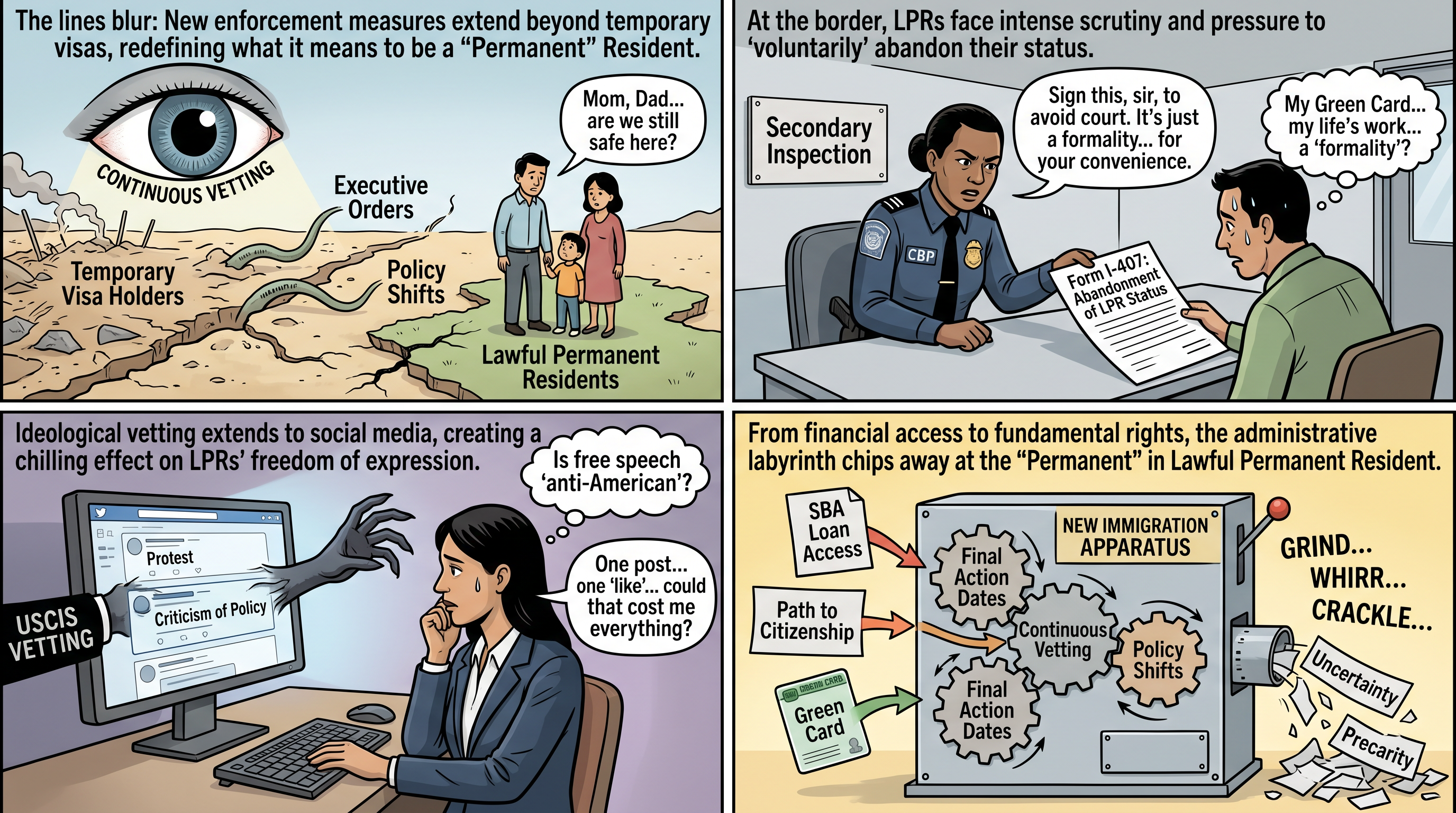
However, the cascading effects of the 2025–2026 immigration directives extend far beyond temporary visa holders, deeply penetrating the rights, financial mobility, and daily lives of Lawful Permanent Residents (LPRs), commonly known as Green Card holders. Through the deployment of an artificial intelligence-driven "continuous vetting" apparatus, the establishment of the centralized United States Citizenship and Immigration Services (USCIS) Vetting Center in Atlanta, and aggressive enforcement tactics at U.S. ports of entry, the historical boundary protecting permanent residents from the precariousness of temporary visa holders is increasingly blurred [cite: 5, 6, 7].
This exhaustive research report dissects the recent policy changes, identifies the primary vectors of public search interest and concern, separates verified administrative actions from widespread misinformation, and models the future trajectories of U.S. immigration enforcement.
Part 1: Identifying Public Search Intent and Core Areas of Debate
An analysis of digital search trends, legal consultations, and public discourse in May 2026 reveals a state of acute anxiety among Lawful Permanent Residents, their families, and their corporate employers. The public is actively attempting to verify the scope of new enforcement measures, driven by a combination of actual policy rollouts, aggressive political rhetoric, and conflated legislative proposals. The primary areas of public inquiry can be categorized into four distinct domains: border re-entry risks, ideological surveillance, financial disenfranchisement, and legislative threats to the high-skilled immigration pipeline.
Border Scrutiny and the Weaponization of Form I-407
Lawful Permanent Residents are heavily researching the parameters of the so-called "6-month rule" and the escalating risks associated with international travel [cite: 8]. Following the expansion of continuous vetting mandates, U.S. Customs and Border Protection (CBP) officers are subjecting returning LPRs to intense secondary inspections, particularly those traveling from or maintaining citizenship in countries identified as high-risk under current executive orders [cite: 8, 9].
The core of the public debate centers on reports of CBP officers pressuring returning LPRs into signing Form I-407 (Record of Abandonment of Lawful Permanent Resident Status). Travelers are attempting to verify whether extended absences automatically void their residency and what their exact rights are when detained at the border without immediate access to legal counsel [cite: 10, 11, 12, 13]. The confusion is exacerbated by instances where officers suggest that signing the form will allow the traveler to "avoid immigration court" or proceed home without detention, masking the reality that signing the form constitutes a voluntary, irreversible surrender of permanent residency [cite: 11, 12].
Social Media Monitoring and "Anti-American" Vetting
A dominant and highly contentious topic of public concern is the formal integration of ideological vetting into routine immigration adjudications. Following DHS and USCIS policy manual updates issued in April and August 2025, the public is searching to understand how "anti-American" or "antisemitic" social media posts affect their legal status [cite: 1, 3, 14, 15].
Because the definitions provided by USCIS remain highly subjective, LPRs and visa holders are actively questioning whether political commentary, participation in campus protests, criticism of the U.S. government, or expressions of support for Palestine constitute grounds for green card revocation or the denial of naturalization [cite: 16, 17, 18, 19]. This has sparked a fierce national debate regarding the First Amendment rights of non-citizens, the chilling effect on free speech, and the extent to which digital footprints can be utilized by the federal government to impose administrative penalties [cite: 5, 16, 19].
Financial Exclusion: Mortgages, Loans, and Tax Credits
Economic anxiety has surged due to shifting eligibility requirements for federal financial programs. Search queries indicate immense confusion regarding access to Federal Housing Administration (FHA) loans and Small Business Administration (SBA) loans [cite: 20, 21, 22]. The public is attempting to verify claims that immigrants can no longer buy homes or start businesses in the United States. This confusion stems from a conflation of the rules applied to temporary visa holders with those applied to Lawful Permanent Residents [cite: 23, 24]. Concurrently, reports regarding the Treasury Department's move to prevent non-qualified aliens from claiming refundable individual income tax credits beginning in tax year 2026 have amplified concerns regarding the broader economic disenfranchisement of the immigrant community [cite: 25].
Legislative Panic: The "End H-1B Visa Abuse Act"
While technically concerning nonimmigrant F-1 and H-1B pathways, the introduction of the "End H-1B Visa Abuse Act of 2026" on April 22, 2026, by Representative Eli Crane (R-AZ) has generated massive search volume and panic across the high-skilled immigrant community [cite: 26, 27, 28]. Because the proposed bill seeks to eliminate the Optional Practical Training (OPT) program, establish a $200,000 minimum salary floor, cut the annual H-1B cap from 65,000 to 25,000, and critically, prohibit H-1B holders from adjusting their status to permanent residency while inside the United States, it is viewed as a total, structural severance of the student-to-green-card pipeline [cite: 26, 29, 30, 31]. The public is heavily debating whether this bill has passed, when it takes effect, and how it impacts the existing backlog of Indian and Chinese nationals waiting for employment-based green cards [cite: 29, 32].
Part 2: Fact-Checking Central Claims and Explanations
The rapid proliferation of executive actions, inter-agency memos, and legislative proposals has created an environment rife with misinformation. To accurately assess the risk landscape for Lawful Permanent Residents, it is necessary to rigorously separate verified administrative facts from disputed claims, misunderstandings, and plausible inferences.
Verified Administrative Facts
SBA Loan Exclusion for Green Card Holders Effective March 1, 2026, the U.S. Small Business Administration (SBA) issued a policy update requiring businesses seeking SBA-backed financing to be 100 percent owned by U.S. citizens or U.S. nationals [cite: 8, 21]. This represents a verified, fundamental shift in federal lending. Any ownership stake held by a Lawful Permanent Resident now automatically disqualifies a business from receiving SBA 7(a) or 504 loan guarantees [cite: 21].
The Expansion of Ideological Vetting by USCIS DHS and USCIS have formally expanded social media vetting to include reviews for "anti-American" and "antisemitic" activity. Policy updates dictate that any support, promotion, or endorsement of anti-American ideologies or antisemitic terrorism will be treated as an "overwhelmingly negative factor" in discretionary adjudications [cite: 1, 3, 14, 15]. The State Department has also directed consular officers to review visa applicants' online presence for similar activities [cite: 17]. This policy directly impacts LPRs applying for Naturalization (Form N-400), as well as individuals applying for Adjustment of Status (Form I-485) [cite: 17, 33, 34].
"Continuous Vetting" of Visa Holders and LPRs The State Department and DHS have implemented a sweeping "continuous vetting" system affecting approximately 55 million visa holders and residents [cite: 5, 6]. Instead of point-in-time background checks conducted only during an application phase, automated systems continually cross-reference biometric data, criminal databases, and social media against existing records [cite: 6, 35, 36]. This allows authorities to identify potential grounds for revocation or deportation on an ongoing basis.
Shift to Final Action Dates for Employment-Based Green Cards In a sudden administrative maneuver, USCIS mandated that employment-based adjustment of status applicants must use the restrictive "Final Action Dates" chart rather than the more favorable "Dates for Filing" chart for the May 2026 Visa Bulletin [cite: 37, 38, 39]. This abrupt change immediately halted the ability of thousands of foreign professionals—particularly Indian and Chinese nationals in the EB-2 and EB-3 categories—from filing their Form I-485 applications [cite: 37, 38]. For Indian-born applicants in the EB-2 category, the Final Action Date remains locked at July 15, 2014, requiring applicants to face multi-year waits before a visa number becomes available [cite: 37, 40].
75-Country Immigrant Visa Pause Effective January 21, 2026, the Department of State indefinitely suspended the issuance of immigrant visas at U.S. consulates for nationals of 75 countries deemed "at high risk of public benefits usage" [cite: 1, 41, 42]. While this does not revoke existing green cards or impact applicants adjusting status within the United States, it completely freezes consular processing for individuals waiting abroad [cite: 33, 35, 42]. A separate, related USCIS policy placed a total adjudication hold on immigration benefits for nationals of 39 "high-risk" countries, halting approvals for work permits, green cards, and naturalization ceremonies [cite: 33, 43].
Disputed Claims and Conflated Policies
Claim: Green Card Holders Can No Longer Get FHA Mortgages Fact Check: False (Conflation of Status). The Federal Housing Administration (FHA) issued Mortgagee Letter 2025-09, which eliminated loan eligibility for "non-permanent residents" effective May 25, 2025 [cite: 20, 23, 24]. The public has incorrectly assumed this applies to all immigrants. In reality, U.S. citizens and non-citizens with lawful permanent resident status (Green Card holders) remain fully eligible for FHA programs, provided they submit documentation from USCIS confirming their status [cite: 20, 23]. The policy functionally excludes temporary visa holders, such as those on H-1B or DACA, causing widespread alarm that mistakenly bled into the LPR community [cite: 22, 24].
Claim: Traveling Outside the U.S. for More Than 4-6 Months Automatically Revokes a Green Card Fact Check: Disputed and Legally Inaccurate. Rumors circulating widely on social media claim the "6-month rule" has been shortened to 4 months, resulting in automatic green card confiscation at airport customs [cite: 44]. Legally, under INA § 101(a)(13)(C), an LPR returning from a trip of less than 180 days is generally not considered to be seeking "admission" and is subject to less scrutiny [cite: 13]. Trips exceeding 6 months do trigger heightened CBP scrutiny regarding the "intent" to maintain U.S. residence [cite: 8, 13]. However, CBP officers do not have the statutory authority to revoke a green card on the spot [cite: 10, 11, 12]. While they can aggressively pressure a resident to sign Form I-407 to voluntarily abandon their status, a refusal to sign forces the government to issue a Notice to Appear (NTA) in immigration court, where a judge must determine abandonment based on "clear, unequivocal, and convincing evidence" [cite: 9, 11].
Claim: The "End H-1B Visa Abuse Act" Has Ended the Pathway to Green Cards Fact Check: Premature and Speculative. While it is undeniably true that the "End H-1B Visa Abuse Act of 2026" proposes devastating structural changes to the high-skilled immigration system—including the elimination of OPT, the cessation of H-4 work authorization, and a total ban on H-1B holders adjusting status to permanent residency—it is currently only a proposed bill introduced in the House of Representatives [cite: 26, 28, 30, 32]. It has not been passed by either chamber of Congress nor signed into law. The public panic is mistakenly treating this aggressive legislative proposal as enacted, immediate policy [cite: 27, 32].
Policy Status and Impact Summary
| Policy Area | Current Legal Status | Impact on Lawful Permanent Residents (LPRs) | Impact on Temporary Visa Holders |
|---|---|---|---|
| SBA Business Loans | Enacted (Effective March 1, 2026) | Ineligible. Businesses must be 100% US Citizen/National owned. | Ineligible. |
| FHA Home Mortgages | Enacted (Effective May 25, 2025) | Eligible. Must provide USCIS proof of permanent status. | Ineligible. Non-permanent residents entirely excluded. |
| Ideological Social Media Vetting | Enacted (USCIS Policy Manual) | High risk of scrutiny during Naturalization (N-400) or card renewal. | High risk of visa revocation or entry denial. |
| Form I-407 Border Pressure | Operational Reality at Ports of Entry | High risk of coercion during secondary inspection; but legally voluntary. | N/A (Visa holders can be denied entry directly without a hearing). |
| Immigrant Visa Pause (75 Countries) | Enacted (Effective January 21, 2026) | No immediate impact on current LPRs, but severely delays family reunification processing abroad. | N/A (Only affects immigrant visas, not temporary visas like F-1 or H-1B). |
| End H-1B Visa Abuse Act of 2026 | Proposed Legislation (Introduced April 2026) | Indirect economic/family impact if passed; would reshape future immigrant demographics. | Devastating. Would eliminate OPT and end the F-1/H-1B to Green Card pathway. |
Part 3: Analyzing the Administrative, Legal, and Operational Apparatus
The strict enforcement environment of 2026 is not merely a product of rhetorical shifts; it is underpinned by a massive expansion of the administrative state's technological and bureaucratic capabilities. The integration of artificial intelligence, inter-agency data sharing, and centralized vetting hubs has transformed the operational mechanics of the U.S. immigration system, shifting it from a reactive processing model to a proactive surveillance model.
Operation PARRIS and the Atlanta Vetting Center
The linchpin of the new enforcement apparatus is the USCIS Vetting Center, headquartered in Atlanta and announced in December 2025 [cite: 7]. Its explicitly stated mission is the "enhanced screening" of immigrants for national security, fraud, and anti-American concerns [cite: 7]. This center synthesizes classified intelligence, open-source social media data, law enforcement records, and biometric systems into a unified analysis matrix [cite: 7].
The first major deployment of this apparatus is Operation PARRIS (Post-Admission Refugee Reverification and Integrity Strengthening). Launched in early 2026 with an initial focus on Minnesota, Operation PARRIS subjects thousands of resettled refugees—specifically targeting the estimated 5,600 individuals who have not yet obtained Lawful Permanent Resident status—to intense background checks, re-interviews, and retroactive merit reviews of their initial asylum claims [cite: 45, 46]. This operation utilizes the Atlanta Vetting Center's capabilities to refer cases directly to Immigration and Customs Enforcement (ICE) for arrest and deportation [cite: 45, 46]. The operational blueprint of PARRIS is critical because it demonstrates the administration's willingness and technological capability to re-adjudicate long-settled immigration cases using newly acquired data sets.
The Algorithm of "Continuous Vetting"
The historical paradigm of immigration vetting was episodic: an individual was screened when they applied for a visa, when they entered the country, or when they applied for a green card. The 2026 paradigm relies on continuous algorithmic surveillance [cite: 5, 35]. Driven by Executive Order 14161 and upgraded FBI database integrations, the DHS Integrity data pipeline perpetually screens the estimated 55 million foreign nationals holding U.S. visas or residency [cite: 5, 47, 48].
For applicants interacting with USCIS, this technological shift has altered the fundamental meaning of standard bureaucratic notifications. When a USCIS online portal updates to "Your case is actively being reviewed by an immigration officer," immigration attorneys report that in 2025–2026, this is now frequently an automated trigger rather than human review [cite: 48]. This status update often indicates that an AI-routing system has pinged an identity mismatch, initiated a TECS (Treasury Enforcement Communications System) security screening, matched biometrics against the Consular Consolidated Database, or auto-generated a Request for Evidence (RFE) based on IRS tax inconsistencies [cite: 43, 47, 48].
Operational Realities at the Border: The I-407 Trap
The administrative tightening extends from databases to the physical borders. CBP officers are operating under aggressive enforcement guidance targeting LPRs who spend considerable time abroad. While the law permits LPRs to travel, absences exceeding 180 days reverse the burden of proof, empowering CBP to question the resident's intent to maintain their U.S. domicile [cite: 8, 13, 49].
The primary operational tactic employed during secondary inspection is the presentation of Form I-407. Officers frequently utilize psychological pressure, suggesting that signing the form will "make things easier" or allow the traveler to "avoid court" [cite: 11]. In reality, signing Form I-407 constitutes a voluntary, legally binding abandonment of permanent residency [cite: 10, 11, 12]. If an LPR refuses to sign, CBP lacks the unilateral authority to cancel the green card. Instead, they must issue a Notice to Appear (NTA) in immigration court, transferring the burden to the government to prove abandonment with clear, unequivocal, and convincing evidence [cite: 9, 11]. To mitigate immediate disruption of their daily lives, LPRs placed in removal proceedings can request an ADIT (I-551) stamp, which USCIS can issue by mail, to serve as temporary proof of employment authorization and status while awaiting judicial review [cite: 11].
Part 4: The Legal Battleground and Constitutional Challenges
The aggressive posture of the executive branch in 2026 has inevitably collided with the judicial system. The implementation of ideological vetting, mass surveillance, and indefinite administrative holds has raised profound constitutional questions regarding the rights of non-citizens living lawfully within the United States.
The First Amendment and the "Challenged Surveillance Program"
The most legally contentious element of the 2026 policy matrix is the designation of "anti-American" and "antisemitic" speech as "overwhelmingly negative factors" in discretionary immigration benefits [cite: 1, 15, 17]. Historically, ideological exclusion in U.S. immigration law was largely limited to individuals belonging to communist parties or those actively advocating the violent overthrow of the government [cite: 18]. The 2025–2026 directives vastly expand this scope to encompass highly subjective political commentary, including criticism of U.S. foreign policy, participation in pro-Palestinian campus protests, or posts critical of the federal administration [cite: 16, 18, 19].
This policy has triggered monumental federal litigation. On October 16, 2025, a coalition of major U.S. labor unions—including the United Auto Workers (UAW), Communications Workers of America (CWA), and the American Federation of Teachers (AFT)—filed a lawsuit in the Southern District of New York against the Departments of State and Homeland Security [cite: 16, 17]. The plaintiffs allege that the "Challenged Surveillance Program," which uses AI to track the social media of visa holders and LPRs, exerts an unconstitutional "chilling effect" on free expression, forcing union members and academics into self-censorship out of fear of deportation [cite: 16].
The legal crux of the argument hinges on the extent to which the First Amendment protects non-citizens. While the Supreme Court has previously granted the executive branch broad deference regarding the admission of aliens at the border (the plenary power doctrine), legal scholars argue that non-citizens physically present and lawfully residing in the U.S. possess robust First Amendment protections [cite: 16, 19]. The outcome of this litigation will establish a national precedent regarding whether digital surveillance and immigration enforcement can be leveraged to silence dissenting political viewpoints among the legal immigrant population [cite: 16].
Procedural Due Process and Administrative Overreach
Beyond First Amendment concerns, the administration is facing severe challenges regarding procedural due process and violations of the Administrative Procedure Act (APA). The implementation of indefinite adjudication holds for nationals of 39 designated "high-risk" countries—which effectively freezes green card processing, work permit renewals, and naturalizations—has prompted federal judges to partially block the policy. In April 2026, courts ruled that USCIS cannot legally suspend cases indefinitely without actively processing them, citing the profound harm caused by trapping applicants in endless bureaucratic limbo [cite: 33, 42, 50].
Similarly, the rollout of Operation PARRIS resulted in a rapid class-action lawsuit (U.H.A. v. Bondi). The complaint alleges that the warrantless arrests, unauthorized detentions, and coercive interrogations of lawfully admitted refugees in Minnesota violate substantive and procedural due process, as well as equal-protection principles by targeting individuals based on race, ethnicity, and religion [cite: 45].
Part 5: Secondary and Third-Order Impacts on Daily Life
The macro-level policy shifts of 2026 permeate the micro-level realities of daily life for Lawful Permanent Residents. The erosion of the distinction between "legal" and "illegal" immigration in the context of law enforcement has generated a pervasive, unavoidable climate of apprehension.
Economic and Entrepreneurial Stagnation The March 2026 SBA policy eliminating green card holders from federal small business loans fundamentally alters the entrepreneurial landscape of the United States [cite: 8, 21]. LPRs, who historically represent a disproportionately high percentage of U.S. small business founders, are now cut off from crucial capital required for expansion, equipment purchases, and commercial real estate acquisition [cite: 21]. Because commercial banks often rely on SBA guarantees to mitigate their own risk profiles, this federal policy effectively redlines LPRs out of the primary commercial credit markets.
Furthermore, the heightened scrutiny of the "continuous vetting" process has led to a reduction in the validity periods for certain Employment Authorization Documents (EADs) [cite: 43, 51, 52]. For LPRs awaiting the final adjudication of their naturalization or for families caught in the 75-country visa processing pause, shorter EAD lifespans necessitate constant, costly renewals and expose them to dangerous gaps in work authorization. Employers face significantly increased compliance burdens with Form I-9 reverifications, leading some risk-averse corporations to silently bypass hiring foreign nationals altogether [cite: 51, 52].
The Chilling of Social Integration and Travel The surveillance environment has induced profound self-censorship. Legal advisors, university international offices, and professional associations are explicitly instructing students, scholars, and permanent residents to sanitize their digital footprints, make social media profiles public for review, and abstain from any political discourse that could be misconstrued by an algorithmic filter [cite: 12, 14, 19, 53].
Travel, once a routine and secure aspect of holding a green card, is now viewed as a high-risk liability. The combination of mandatory biometric exit/entry tracking, the potential for arbitrary visa revocations triggered by AI flags, and the aggressive posture of CBP regarding the 6-month rule has effectively trapped many LPRs within the United States [cite: 8, 35, 50, 54]. They forego visiting sick relatives abroad or attending essential international business conferences due to the distinct possibility of facing Form I-407 coercion upon their return [cite: 55].
Local Law Enforcement and the 287(g) Multiplier The daily life of immigrants is increasingly dictated by geography and local state laws. The administration's revitalization of Section 287(g) agreements—which formally deputize local sheriffs and police to perform federal immigration enforcement functions—has effectively localized the border to the municipal level [cite: 56, 57]. In states with robust 287(g) participation, routine traffic stops or minor civic interactions can rapidly escalate into ICE referrals and detention [cite: 56, 58]. Consequently, mixed-status families and even fully documented LPRs often avoid interacting with local municipal services, public schools, or healthcare facilities out of fear that their routine data will be fed into the DHS surveillance apparatus [cite: 58].
Part 6: Predictive Scenarios and Confidence Assessments
Based on the synthesis of current administrative trajectories, legislative proposals, technological capabilities, and judicial pushback, several potential scenarios can be inferred regarding the future landscape for Lawful Permanent Residents.
Scenario A: The "Algorithmic Gridlock"
- Likelihood: High
- Confidence Level: High
- Mechanism: The Atlanta Vetting Center and the "continuous vetting" architecture operate exactly as designed. However, the sheer volume of data integration (IRS records, social media, local law enforcement license plate readers) creates an unprecedented number of false positives.
- Impact: USCIS adjudication times for N-400 (Naturalization) and I-90 (Green Card Renewal) applications grind to a near halt. The system becomes choked with automatically generated Requests for Evidence (RFEs) concerning minor tax discrepancies, hyphenated name mismatches across databases, or misunderstood social media posts [cite: 48]. LPRs will face protracted periods in "actively reviewing" status, forcing them to rely heavily on temporary ADIT stamps for basic employment verification and domestic travel [cite: 11, 48, 59].
Scenario B: Judicial Severance of Ideological Vetting
- Likelihood: Medium
- Confidence Level: Medium
- Mechanism: The federal courts, potentially reaching the Supreme Court, issue a definitive ruling on the UAW/CWA lawsuit regarding social media monitoring and anti-American vetting criteria.
- Impact: The courts are likely to uphold the executive branch's broad authority to conduct extensive vetting at the point of initial entry (consular visa processing). However, they are highly likely to strike down the revocation of status or denial of naturalization for existing Lawful Permanent Residents based solely on First Amendment-protected political speech [cite: 16, 19]. This judicial action would force DHS to separate its continuous vetting algorithms into two distinct tiers: one for temporary visa holders (subject to high ideological scrutiny) and one for LPRs (shielded from subjective ideological tests but still subject to continuous criminal and national security checks).
Scenario C: Legislative Enactment of H-1B Restrictions
- Likelihood: Low
- Confidence Level: High
- Mechanism: The "End H-1B Visa Abuse Act of 2026" overcomes fierce opposition from the technology, healthcare, and higher education lobbies to pass both chambers of a politically fractured Congress.
- Impact: While primarily aimed at F-1 and H-1B nonimmigrants, the passage of this bill would fundamentally and permanently alter the demographics of future Lawful Permanent Residents. By eliminating the OPT program and prohibiting H-1B holders from adjusting status to permanent residency from within the United States [cite: 26, 27, 30], the traditional, decades-old pipeline of international students transitioning to green card holders would be completely severed. Current LPRs attempting to sponsor family members or transitioning from employment visas would be trapped in an unnavigable system, inevitably leading to a massive exodus of high-skilled talent to more permissive economic jurisdictions, thereby severely impacting U.S. economic competitiveness [cite: 31, 32].
Conclusion
The May 2026 immigration updates and corresponding administrative actions do not merely represent a tightening of existing numerical quotas; they signify a profound paradigm shift in the philosophy of U.S. immigration enforcement. The concept of permanent residency is increasingly treated as conditional, subject to the perpetual scrutiny of algorithmic continuous vetting, aggressive social media monitoring, and hostile border interrogations.
For Lawful Permanent Residents, the foundational legal protections associated with the Green Card remain structurally intact—CBP officers cannot unilaterally revoke status without a judicial hearing, and the courts remain a viable bulwark against administrative overreach. However, the administrative friction imposed on their daily lives has increased exponentially. Through targeted financial exclusions in federal lending, the weaponization of bureaucratic procedures at ports of entry, and the looming threat of ideological algorithms assessing their loyalty, the system appears designed to induce compliance and self-censorship through attrition. As the technological apparatus of the Atlanta Vetting Center matures and the federal judiciary begins to define the limits of the First Amendment in the digital age, Lawful Permanent Residents must navigate a landscape where securing a Green Card is no longer the final step in their immigration journey, but rather the beginning of an ongoing mandate to continually prove their value, economic independence, and ideological allegiance to the United States.
Sources:
- nafsa.org
- nafsa.org
- nafsa.org
- visaverge.com
- brennancenter.org
- visaserve.com
- lawfirm4immigrants.com
- youtube.com
- immigrationissues.com
- orangelaw.us
- verdinlaw.com
- safeabroad.com
- lawandborder.com
- georgetown.edu
- natlawreview.com
- newsweek.com
- brennancenter.org
- timesofisrael.com
- latinonewsnetwork.com
- luminate.bank
- grantspasstribune.com
- aba.com
- nar.realtor
- mpamag.com
- treasury.gov
- haymanwoodward.com
- manifestlaw.com
- visahq.com
- sundayguardianlive.com
- republicworld.com
- ndtv.com
- rnlawgroup.com
- mmhpc.com
- abil.com
- meltzerhellrung.com
- nfap.com
- ogletree.com
- manifestlaw.com
- gibney.com
- colombohurdlaw.com
- gibsondunn.com
- ucdavis.edu
- leenovi.com
- reddit.com
- immpolicytracking.org
- hstoday.us
- uscis.gov
- lawfirm4immigrants.com
- nilc.org
- colombiaone.com
- visahq.com
- klaskolaw.com
- eb5insights.com
- nysba.org
- reddit.com
- rsfjournal.org
- thedailytexan.com
- raygriffithlaw.com
- dhs.gov